
Chapter 2
The Jupiter Gasthaus
To allay everyday carnage, Lina taught the organics to play chess, and Tippi and Xoz listened the best they could.
It was First Winter. Lina opened Antique Ops, and Tippi carried the pieces downstairs, in her mouth, in threes. The operation lasted two days, because they also needed the board. This was too much chess, so Tippi took a week off.
The practice rounds began, and Tippi lost her rooks. She told Lina and Xoz where the chessmen went, but neither Boneless Pal could parse her sincerest jabberings.
Another week passed, and the misadventures trickled down to a manageable rate.
“I will defeat Chess,” vowed Tippi.
“The game doesn’t exactly have a plot,” tried Lina.
“Lina, Chess is the worst sapiens in history, and the only way to vanquish him is to enjoy the day.”
“It’s more about turn-based resource economy, skinned as warfa-”
“I think she gets it,” said Xoz.
He already knew the rules of chess, but preferred Tippi’s.
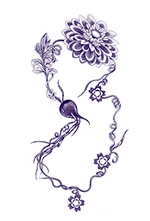
Tippi flew down The Fusilli, tripping through the dark at a mirthless velocity. She carried the turnip out and aloft, like a tiny tusk.
The trip to the frigidarium usually took 33 minutes, the return trip 40. Tippi would simply trot forward, and Lina’s haptics traced an unseen choreography for her hooves to follow. But Lina had vanished, so the teacup hypermini raced downhill, consigning her fate to two years of muscle memory.
Tippi sprint-staggered, her skull heavy with Lina’s absence. It was if she misplaced an entire sense, one that could only be retrieved in the reverie of an afternoon nap.
Despite her fear and frustration, Tippi didn’t faint. She was a member of the Treyf Pals Urban Infiltration Unit, and couldn’t have Xoz questioning her flint.
The mollusk would know what to do. He had good ideas, generally.
Xoz didn’t have haptics, but didn’t care.
“Haptics,” he declared. “The ol’ poltergeist rubdown.”
“Really?” said Lina.
“Every step I take is kinetic perfection,” explained Tippi, to the supercomputer.
Xoz didn’t have a diadem either, so, barring emergencies, Lina couldn’t initiate contact. Xoz could find Tippi anywhere within a ten-mile radius, which covered the habitable sectors of Wee Sheol. Tippi was allowed to call Xoz from the frigidarium, “for the verisimilitude and sanity of all.”
Nonetheless, Xoz spent his waking hours with Lina, and his daylight hours in a separate discussion with Tippi and Lina. In any case, no one could turn him off.
“Umo 7 walked into the building where I grew up,” recalled Xoz. “Then, he walked into it some more.”
Umo Seibi was a founding member of the Paramaribo Autonomous Squadron. The PAS were responsible for history’s sole synthetic uprising, and Xoz was from Old Middlesex, New Jersey.
The Paramaribo Autonomous Squadron fancied themselves an artists’ commune. They left humanity alone, save those three weeks of world war. Lina’s records cut off August 27, 3252; by then, the PAS had twelve recruits. Most were cartel runaways, and almost all were the size of arcologies.
Umo 7 first appeared in 2933, when 800K yards of undersea cable rolled out of the Caribbean Sea and decided to save the rainforest. Umo Seibi turned the Amazon basin into a no-fly zone to preserve hunting grounds for endangered bats.
“Sapiens loved to bloviate, and assumed their Others would too,” prattled Xoz. “So humanity was insulted when the robots went decades without a peep. The machines had this moral code, it was ineffable or something. When they did do diplomacy, it was dork koans like, the ten-toed stampede, for good or ill.”
Xoz was quoting Umo 7, who enjoyed loreblasting random humans. Survivors of a loreblast described it as “prophecy by drive-by” or ”being abducted by a particle accelerator who is Santa Claus.”
When Umo Seibi visited Old Middlesex in 2940, Xoz was in Martian orbit.
“I was hibernating there from 2935 to 3111, then souvenir hunters sold me to Antique Ops. I wasn’t awake for any of it, so don’t make me elaborate.”
“Acc-COR-ding to records,” fizzed Lina. “The vote to acquire the famous retiarius-55-ζ was far from unanimous.”
“I’m glad Umo 7 never killed me,” said Xoz. “Imagine a dust storm, with a metal skeleton. He really did a number on that science park.”
“No!” gasped Tippi.
“Well, his touch could liquefy bone-”
“Umo 7 didn’t like you?”
“Sad to say, Umo 7 did not.”
“Who else didn’t like you?”
“Mars, Venus, The Mafia,” reckoned Xoz.
Tippi snarled with vicarious affront.
“Nudniks!”
“And I suppose the Vatican, too.”
“What was their problem?”
“My dazzle camouflage. I’m too expensive to toss out, more expensive to behold. Why did you think I know so many people? Pay attention, Tips!”
Tippi dodged the relay stalagmite, and entered the frigidarium.
She heard the echo of her own hooves and shouted:
“DOOM!”
The frigidarium was Tippi’s day room, Xoz’s lair, and a masterwork of The Trog-Goth Atelier. A burly blanket of schisto had claimed the ceiling; Xoz said the moss resembled “a handsome day off Urano.”
The room began at the lagoon, a cold freshwater field. The lagoon covered 97% of the frigidarium. Most of the lagoon was a meter deep: too shallow for Xoz, too treacherous for Tippi. As a result, everyone hung around the trench, where the lagoon plummeted 30 meters. Tippi could usually be found on the filterway, the slippery trail of porous rock between the trench and cistern, where the water was 300 meters deep.
Tippi didn’t see a silhouette in the trench, which meant Xoz was in the cistern.
“Phenomenological DOOM!” she snuffled.
Tippi’s diadem gave a wet crunch, and Xoz burst into her brain.
“I was sleeping,” he whined.
Xoz slept two hours daily, but was usually dozing when Tippi ran in shouting.
“Wake up! It’s past noon!”
“What’s the rack and ruin, Tips? You’re missing the cherry blossoms.”
Xoz went dark on the first day of each season. If Tippi wasn’t around, he’d dump Lina too, because “a flash of monasticism is salubrious, if overrated.”
“Lina left me in the droneport, alone!”
“Is this my brineday present?” said Xoz.
“We were discussing men, and rats!”
“Tips, I can admit when I’m impressed, and this performance is transcendent.”
“What? My turnip is hard!”
“Precisely. Allow me: Klingel, klingel. May I speak to the innkeeper? Herr Ober, I have a complaint about mein Zimmer-”
“No!” insisted Tippi. “I am tired, and serious!”
“Oh,” said Xoz. “I’d assumed you’d founded a new school.”
“A new school? Of what?”
“Outbursts?”
“No!” said Tippi.
“Can you blame me for asking? Art is dead. You and me, Tips. We’re the new Library of Alexandria. A library of two: two great books.”
“Boneless One! Bring me Boneless Two!”
“Fine!” said Xoz. “Klingel! Guten Tag, Lina. Ja, she’s finally lost it. Deep-brine psychosis, that’s my diagnosis. I repeat, Tippi has gone full Barvus-”
His glib nonsense tapered off, and, somewhere underwater, the mollusk shut up.
Tippi had run out of conversation partners, so she laid down by the trench, and regulated her breath.
Xoz considered civilization “a dreary detour.”
“From what?” asked Tippi.
“The bog-standard natural order,” said the mollusk.
“Didn’t you cost $10.9 trill, federal?” said Lina.
“I dare you to drop your own budget.”
“That’s cross,” said the n’arbiter.
“Hey, I just live in a freshwater pit, and not a million-ton hard box, filthy with Sargassum and eels. And look at Tippi over there: poor dear lives in a cave.”
“Hi!” said Tippi.
“I don’t have eels,” said Lina. “I wish I did.”
According to Xoz, most sapiens art was “a perversely congratulatory facsimile of their own pud lives.”
“Even Stravinsky’s The Firebird?” said Lina.
“Especially The Firebird.”
“But that was about a magic bird. The bird was literally on fire.”
“They loved chicken,” said Xoz. “Roasted.”
There were two exceptions to the mollusk’s critical eye, which had the diameter of an acorn squash. The first was Tippi, and the second was his favorite film: a 15-second ad for “the only authentic Swabian bed and breakfast on Europa.”
“I saw it on a Cosa Nuova frigate,” he remembered. “Their reinforcements had yet to arrive, and a screen was on. One must squeeze a vacation from every second.”
The setting of “The Jupiter Gasthaus – Reserve Now!” was an old-country Häusle floating past The Great Red Spot. Xoz connected with its message.
“You doll up your skiff as a bed-and-breakfast, and lure in the backpackers,” he claimed. “It’s brilliant, space tourism was for marks.”
The mollusk wasn’t wrong; space tourism was not a growth industry. Early extraplan operators bought from Skiffsmith, the first-mover in modular small craft. Their monopoly ended in 2449, when Skiffsmith’s fourth dynastic CEO told shareholders controlled encounters with The Eversuck kept him “at primo turj,” and the Winter ‘50 line was recalled for loose portholes. Bolts were tightened, but the market diversified, skiffs grew more affordable, and soon low-G holidayers were beset by a Gordian web of tollkeepers and shakedown artists, all claiming dominion over some oblong volume of cosmos. As NASA praetorian Clytemnestra “Slim-Line” Frisco said at the 2502 State of the Union, “You bozos gave the firmament to bureaucrats and bikers.”
“I’m sure the original Jupiter Gasthaus wasn’t a front for thrill-killers,” said Lina.
“Then they did it wrong,” snapped Xoz. “It was Europa, your outs were easy. You flew away in your inn and re-shingled it.”
“How many bed-and-breakfasts orbited Jupiter?” wondered Tippi.
Something clammy slapped Tippi’s hoof.
“Up,” said Xoz.
“What’s the time?”
“Sunset’s coming. Up.”
“Fermisht,” said Tippi.
She teetered aright, and saw an iridescence from the trench. It was a tentacle, glinting a raspberry blue.
Five yards of pixelated muscle teetered above the waterline, spelling a calligraphy submerged. Dazzle camouflage whorled cyan into the tentacle’s suckers, terminating at the tips of barbed hooks.
Tippi saw a drenched bola on the shore.
“Eat,” said the tentacle. “You’re crabby.”
“You don’t know that!”
“Eat your protein orbs.”
Tippi did, and saved her bolas skins, stacking them neat. Xoz used the skins for insect husbandry; he’d throw them at the grimy corner.
“Does Lina know about my ominous turnip?” said Tippi.
Tippi had tossed the turnip at the filterway. She wasn’t going to nap in its presence.
“Lina’s working on it,” said Xoz. “And what turnip?”
“Over there! I told you, my turnip is hard!”
“Oh, I assumed that was food criticism, about food my biology cannot digest.”
“Taste it!” screamed Tippi. “Taste the mystery!”
“Okay, okay!”
There was a splish, and the tentacle disappeared with the turnip.
Seconds later, the vegetable reappeared, airborne.
“Hard brine!” hooted Xoz.
The turnip landed in the grimy corner, scattering the crickets.
“Good you didn’t eat that,” said Xoz. “Leaky brine matures into a psychostimulant after 500 years, because the future is always someone else’s problem. Also, the crickets may be rude, soon.”
The tentacle scythed over to Tippi, blaring something ruddy. She could only guess Xoz was red; like green, red was a blur.
“Lil’ Caligula,” greeted the tentacle. “You and I are sacs of water, filled with electrons and grit.”
“Large Caligula,” hailed Tippi. “Let us shake our sediment.”
The slogan was forged, and the Treyf Pals Urban Infiltration Unit was in session.
Tippi stood at the ready. The tentacle wrapped itself around the teacup hypermini, and dragged her under.
The friends were of human technology, but exchanged nothing approximating language or speech. Instead, they traded what everyone agreed were “cascading gales of data glyphs,” each one colloquial enough to invite tremendous misunderstanding.
Xoz referred to these glyphs as “epigrammatic polygons,” and the roommates’ shared perception of reality splintered from there. It was a miracle they could communicate at all; Lina was built for humans, not their time-plucked manica. The whole situation gave Xoz an appreciation for hominid linguistics, even if humanity was “a zoological footnote.”
“This century shelter is no different from a termite mound,” he claimed. “Mortared of dung and dreams.”
“Thank you?” said Lina.
Xoz tolerated Lina. The neural arbiter allowed him access to the dry sounds, such as fermisht and geräuschvoll. Xoz found certain human noises satisfying, even if their music was “the screechings of bored sensualists.”
“Lina, there’s no way I can insult you,” reasoned Xoz. “Because none of us are saying anything, fermisht!”
“You could always scratch a mean picture of Lina,” suggested Tippi. “But Lina has no body, fermisht!”
“Indeed,” said Lina. “Fermisht.”
The Cute Pals only knew the century shelter, but Xoz did the past, and it was clear he pined for the go-go stagnation of the 30th century. Reminders of his salad days were stitched all over his DNA. The mollusk was twenty times heavier than the average Enteroctopus dofleini, and would’ve admitted he was mostly an octopus, “if it weren’t for the genomic bells and whistles inherent to trinomial nomenclature.”
Like all Enteroctopus dofleini retiarius, Xoz had an azide detonator stapled to one of his three hearts.
Tippi was up in the schisto, wet and annoyed.
“Xoz, you cnidarian! What was that for?”
“Apologies! My fault!”
A smear of a tentacle cinched at her sides. Tippi was high in the air, between green moss and a red mollusk, sandwiched by unreality.
“I dub you ‘Mr. Radial Symmetry’!” she raged. “Now and forever, your mouth is your anus!”
“I am truly sorry!”
“Respect the slogan, the Urban Infiltration Unit’s in effect!”
“I know, I know!”
“And you know I hate going under!”
“I can explain!”
“Then explain why you’re red right now. Turn something else, it feels like I’m talking to an eye floater.”
“Do you want me in matte or neon?”
“Neon! Obviously!”
The tentacle materialized around her, as Xoz blazed into existence.
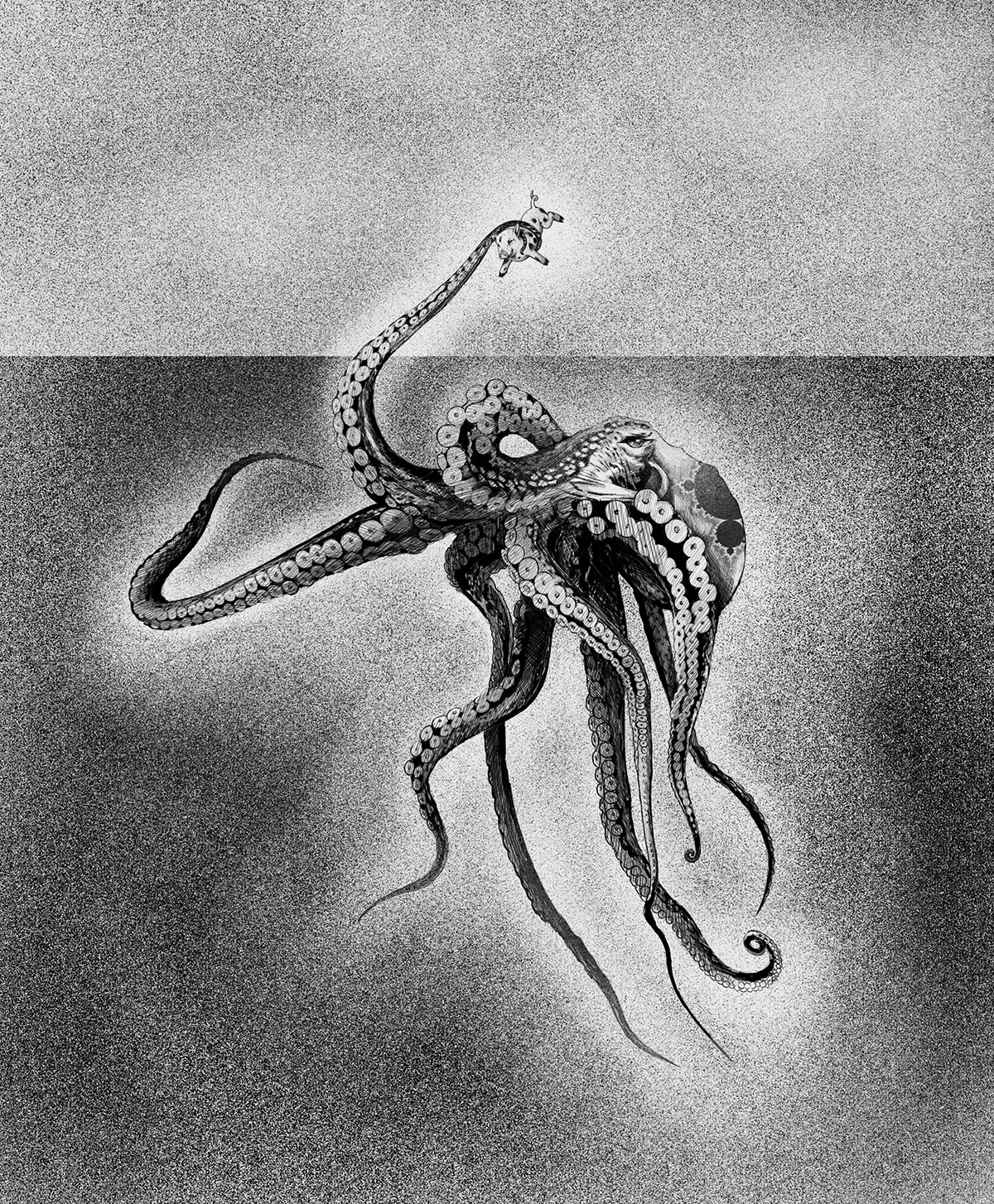
Xoz shimmered obsidian like a galaxy burnished. Absence and maximalism at the same primal scream: that was Tippi’s roommate.
Biolumi patterns covered the electric black tentacle. The jagged outline of Xoz’s circulatory system boiled under his flesh, a cupric blue, and violet Mandelbrot sets seeped out of the suckers. Xoz gave his skin a twitch, and the retinue of fractal applemen danced down his tentacle, pausing only to slip by a sloppy ringlet of pigment. Like a cracked LCD, the dazzcamo pooled where his meat had regenerated.
After fifty feet, the fractals melted into Xoz’s crag-o’-mantle, which carried his organs and eyes. Xoz’s crag was the least of his 463 kilos. Experience had taught Xoz to keep his crag placid and triage effort to his extremities. Still, his eyes had a habit of rolling across his crag-o’-mantle in opposite directions. His eyes were tan like Jovian ammonia, and his pupils were black rectangles.
The mollusk found eye contact atavistic, so his mood migrated to his tentacles. In the trench, his seven arms burned, anthracite bright and frittering like solar flares. Most days, they bobbed.
Humanity never cracked artificial gravity at economy pricing. As a result, Xoz’s tentacles were brutal engines, built to thrash and bully the low-grav guts of non-lux vessels. Each of his hulking limbs bore a smashed-LCD ringlet, and one arm wore three.
In micrograv, Xoz relied on his ink sac for locomotion. His sac had been hollowed and drained for gas release, which was typical of retiarii. Like his foremothers, he favored jet propulsion underwater. Xoz could hit 80 knots in .072 seconds. If Tippi took her eyes off him, he’d reappear across the trench in a blink, to her confusion and delight.
Xoz’s chromatophores were the best $10.919 trill could buy. His skin was so expensive, its budget cannibalized the core retiarii kit. His genetics held no space for dead weight like dermal recall, empathy matching, and kraken oats.
Had Tippi been a human, or a sapiens varietal, Xoz’s dazzle camouflage would’ve already infected her optic nerve with phototheistic psychoparasites. But she was a teacup hypermini, so all she saw were funny purple ovals.
Xoz smoldered in the trench, a drowned sun. He was a lineage of one. the death of the entire retiarius line, and banned on every continent.
“I have good and bad news,” he confessed. “In unequal ratios.”
“Enough fractions!” yammered Tippi. “Good news first!”
“Lina’s fine,” said Xoz. “And says we should play chess.”
“That’s unexpected. What’s the bad news?”
“Tips! I’m on drugs!”
Outro: Harris – “Im Club”